
5 Core Exercises Every Woman Over 40 Should Do (No Crunches Needed)
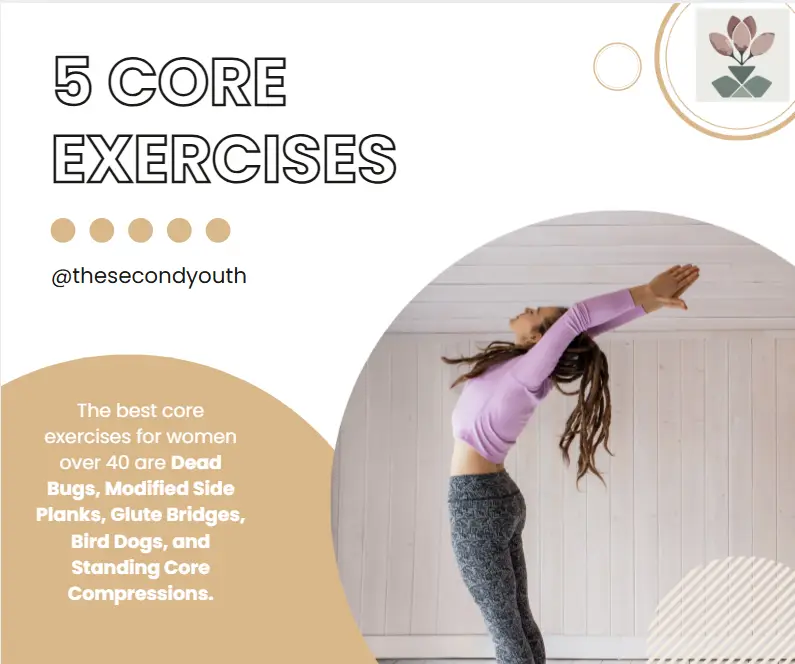
The best core exercises for women over 40 are Dead Bugs, Modified Side Planks, Glute Bridges, Bird Dogs, and Standing Core Compressions. These movements are crunch-free, low-impact, and functional. They specifically target and strengthen the deep abdominal and stabilizing muscles, providing crucial protection for the lower back and pelvic floor—elements often overlooked in traditional core routines.
Why Core Strength Matters More After 40: The Midlife Advantage
Your 40s are a powerful decade, a time of clarity and capability. However, this period also brings distinct physical shifts that necessitate a more intentional approach to fitness, especially core stability.
As women enter perimenopause and beyond, hormonal changes (particularly the decline in estrogen) contribute to several physical shifts that directly impact core health (Collins, Laakkonen, & Lowe, 2019):
- Natural Muscle Mass Decrease (Sarcopenia): Core muscles, like all others, begin to decrease in size and strength, making stability more challenging.
- Balance & Proprioception Decline: The body’s ability to sense its position in space naturally diminishes, making deep, reflexive core stability more vital for fall prevention.
- Pelvic Floor and Spinal Load: Years of life, and often pregnancy, require sustained strength from the deep core unit to manage intra-abdominal pressure and support the spine.
A strong, functional core helps you navigate these changes, allowing you to:
- Move Confidently and Effortlessly
- Support and Stabilize Your Spine
- Improve Posture and Reduce Slouching
- Significantly Reduce Lower-Back Discomfort
- Build Balance, Stability, and Agility
- Maintain and Support Pelvic Floor Health
- Feel Stronger, More Grounded, and Resilient in Daily Life
The Critical Flaw of Traditional Crunches in Midlife
Here’s the truth most women don’t realize: traditional crunches DO NOT support real midlife core strength and can be counterproductive, particularly for the over-40 body.
Crunches tend to:
- Work the Outer Abdominals: They primarily engage the rectus abdominis (the “six-pack muscle”) rather than the deep core stabilizers (transverse abdominis and multifidus).
- Strain the Neck and Spine: They often encourage forward head posture, leading to neck strain and discomfort.
- Pressure on the Pelvic Floor: They create significant downward intra-abdominal pressure, which can weaken the pelvic floor.
- Worsen Abdominal Doming: They can aggravate or contribute to diastasis recti (abdominal separation), leading to bulging in the mid-section. (Skoura et al., 2024)
Midlife bodies require low-impact, functional movements that strengthen the core from the inside out. The following five exercises are chosen specifically for women over 40 who prioritize flexibility, strength, balance, and real functional fitness without pain or strain.
The 5 Best Core Exercises for Women Over 40 (No Crunches Required)
Each movement supports your spine, pelvic floor, and balance—essential for women navigating midlife strength changes.
The Dead Bug (The Ultimate Deep Core Activator)
Why it’s powerful for women over 40:
The Dead Bug is considered the gold standard for transverse abdominis (TA) activation (Central Ohio Spine and Joint, 2025). The TA is your body’s natural corset, crucial for spinal support, posture, pelvic stability, and balance—all areas that weaken with age. It trains your limbs to move while your core remains perfectly stable.
How to Master the Dead Bug:
- Starting Position: Lie on your back with arms straight up toward the ceiling. Lift your knees so they are bent at 90 degrees (shins parallel to the floor). Flatten your lower back gently into the mat.
- The Breath: Inhale deeply. As you exhale, gently pull your belly button toward your spine—this is the core lock.
- The Movement: Maintaining the core lock, slowly and with control, extend your right leg toward the floor and your left arm toward the ceiling behind you. Do not let your back arch or lift off the floor.
- Return: Inhale as you return your arm and leg to the center.
- Switch Sides: Exhale and repeat with the opposite arm and leg (left leg, right arm).
Reps: 6–10 slow, controlled repetitions on each side.
Benefits:
- Builds deep abdominal and spinal stabilizing strength.
- Improves spinal support and protects the lower back.
- Enhances cross-body coordination and midlife stability.
Modified Side Plank (Waist and Hip Stabilizer)
Why it’s great for midlife:
Side planks are powerful for strengthening the obliques, the hips (gluteus medius), and the pelvic floor. Strong side muscles are essential for walking, running, maintaining balance, and preventing the kind of rotational strain that leads to lower back pain. The modified version reduces leverage, making it safer and more accessible. (Wellen, n.d.)
How to Master the Modified Side Plank:
- Starting Position: Lie on your side with your knees bent to 90 degrees. Place your elbow directly under your shoulder.
- The Lift: Engage your core and glutes. Lift your hips, forming a straight line from your shoulders down to your knees. Your body weight should be distributed between your forearms and the sides of your knees.
- The Hold: Maintain a neutral spine and neck. Avoid sinking into your shoulder or letting your hips droop. Maintain steady, diaphragmatic breathing.
- The Release: Lower your hips slowly with control.
Hold: 15–30 seconds per side. Rest for 10 seconds, then repeat on the other side.
Benefits:
- Strengthens the oblique muscles and hips (crucial for walking).
- Improves standing balance and lateral stability.
- Reduces the risk of rotational lower-back discomfort.
Glute Bridge with Core Activation (Posterior Chain Power)
Why it’s essential:
Weak glutes, hamstrings, and an underactive posterior chain are a massive contributor to back pain and poor posture—both incredibly common after 40. This movement effectively strengthens your glutes and lower back while demanding gentle, sustained activation of the deep core and providing safe support for the pelvic floor. (Quinn, 2024)
How to Master the Glute Bridge:
- Starting Position: Lie on your back with your feet flat on the floor, hip-width apart, knees pointing toward the ceiling. Your heels should be close enough that you can lightly touch them with your fingertips.
- The Core Lock: Take a small exhale and gently draw your belly inward (core engagement).
- The Lift: Slowly lift your hips toward the ceiling by engaging your glutes and hamstrings. Do not lift so high that your ribs flare or your lower back arches excessively. Your body should form a straight line from your shoulders to your knees.
- The Pause: Pause briefly at the top, squeezing your glutes.
- The Lower: Lower your hips slowly and intentionally, one vertebra at a time, until you return to the starting position.
Reps: 10–15 controlled repetitions.
Benefits:
- Strengthens the posterior chain (glutes and hamstrings).
- Supports pelvic floor health by promoting proper hip alignment.
- Improves mobility and corrects anterior pelvic tilt (poor posture).
Bird Dog (Cross-Body Co-ordination and Alignment)
Why midlife bodies love this exercise:
The Bird Dog is a fundamental functional exercise that builds cross-body strength (training the opposite arm and leg to work together), improves spinal alignment, and significantly increases dynamic balance—one of the first functional aspects to decline during midlife. (Cronkleton, 2023)
How to Master the Bird Dog:
- Starting Position: Begin on your hands and knees (quadruped position). Ensure your hands are directly under your shoulders and your knees are under your hips. Maintain a flat, neutral back (like a table).
- The Core Lock: Engage your core slightly, as if bracing for a light touch.
- The Extension: Extend your right leg straight back, and your opposite arm (left) straight forward. Think about reaching long, not lifting high.
- Alignment Focus: Keep your hips perfectly level; avoid letting your torso rotate or arch. Your gaze should be on the floor.
- The Return: Return slowly and with control to the starting position.
- Switch Sides: Repeat on the opposite side (left leg, right arm).
Reps: 6–10 slow, controlled repetitions per side.
Benefits:
- Dramatically improves dynamic stability and balance.
- Reduces non-specific lower back pain by stabilizing the spine.
- Strengthens deep core layers and improves full-body coordination.
Standing Core Compression (Functional, Real-World Strength)
Why this belongs in every woman’s over-40 routine:
Most of life happens standing up. Standing core work trains your body in the way it actually moves, transferring strength to everyday activities like walking, carrying groceries, or climbing stairs. It strengthens your center without lying down, making it ideal for busy women, beginners, and anyone with existing back or neck discomfort. (Lederman, 2023)
How to Master the Standing Core Compression:
- Starting Position: Stand tall, feet hip-width apart. Relax your shoulders.
- The Lift & Exhale: Gently lift one knee (left or right) until your thigh is parallel to the ground (or as high as comfortable). As you lift, exhale fully and gently pull your lower abdominals inward and upward (the “compression” feeling).
- The Hold: Briefly hold the compression and the balance.
- The Switch: Lower the leg with control and immediately switch sides, repeating the full exhale and compression as you lift the other knee.
Reps: 10–12 controlled repetitions per side.
Benefits:
- Strengthens the lower abdominals (perfect crunch alternative).
- Improves static balance, posture, and mobility for daily tasks.
- Trains core muscles in a functional, upright position.
The Importance of Breathwork and Intra-Abdominal Pressure
A key element of effective core training after 40 is managing intra-abdominal pressure (IAP). This is the pressure within your core cavity, which, if improperly managed (as often happens with crunches or holding your breath), strains the pelvic floor and can worsen diastasis recti.
The Golden Rule: Always exhale on the effort (the hardest part of the movement).
- Dead Bug: Exhale as you extend the arm/leg.
- Glute Bridge: Exhale as you lift the hips.
- Standing Compression: Exhale as you lift the knee and compress the core.
Proper breathing engages the transverse abdominis, protects the pelvic floor, and increases the efficiency of your core workout.
A 10-Minute Weekly Core Routine (Beginner-Friendly & At-Home)
Consistency is the secret ingredient. Repeat this short, effective routine 2–3 times per week to see tangible improvements in strength and stability.
Exercise | Repetitions/Hold Time | Focus |
Dead Bug | 6–10 repetitions per side | Spinal Stability |
Modified Side Plank | Hold 20–30 seconds per side | Oblique & Hip Strength |
Glute Bridge | 10–15 repetitions | Glutes & Pelvic Floor |
Bird Dog | 6–10 repetitions per side | Balance & Coordination |
Standing Core Compression | 10–12 repetitions per side | Functional Strength |
- Total Time: Approximately 8–10 minutes
- Equipment: None (all are bodyweight exercises)
- Impact Level: Low (suitable for most fitness levels)
This is the ideal at-home core routine for women over 40 who want real, functional strength built on gentle, safe movements.
The Emotional Layer: Midlife Strength = Inner Resilience
A strong core influences far more than your physical body. It affects your confidence, your energy, your posture, your mood, and even how grounded you feel throughout your day.
Women over 40 who focus on deep core strength often describe feeling:
- “More stable and grounded in every position.”
- “Lighter, with improved balance and better posture.”
- “More in control of my body during everyday movements.”
- “More confident in my fitness abilities.”
This isn’t just a workout routine; it’s a pathway back to your inner strength and long-term vitality. By prioritizing these safe, functional core exercises, you invest in a stronger, more resilient future.
FAQ
What are the best core exercises for women over 40?
Dead bugs, modified side planks, glute bridges, bird dogs, and standing core compressions are highly recommended, as they safely and effectively build deep core strength without relying on crunches.
How many times per week should women over 40 train their core?
Two to three focused, short core sessions per week are ideal for building and maintaining deep strength and stability.
Can these exercises help with lower-belly fat?
While these exercises strengthen the core muscles beneath the fat, targeted fat loss requires a combination of overall strength training, cardiovascular movement, and balanced nutrition.
Are these exercises safe for women with diastasis recti?
Yes, all five of these movements (Dead Bug, Modified Side Plank, Glute Bridge, Bird Dog, and Standing Core Compression) are considered safe and beneficial for strengthening the core while protecting the abdominal wall from the excessive pressure caused by crunches.
Do I need equipment for this core routine?
No, all five exercises are bodyweight movements that can be done at home on a mat with no special equipment needed.
Can these low-impact core exercises help reduce lower back pain?
Yes, strengthening the deep core muscles, especially the transverse abdominis (targeted by the Dead Bug and Bird Dog), is one of the most effective strategies for supporting spinal health and reducing chronic lower back pain.
References
- Collins, B. C., Laakkonen, E. K., & Lowe, D. A. (2019). How the loss of estrogen impacts skeletal muscle strength, bone, and the immune system. Frontiers in Physiology, 10, 1–13. https://doi.org/10.3389/fphys.2019.00532
- Skoura, A., Billis, E., Papanikolaou, D. T., Xergia, S., Tsarbou, C., Tsekoura, M., Kortianou, E., & Maroulis, I. (2024). Diastasis recti abdominis rehabilitation in the postpartum period: A scoping review of current clinical practice. International Urogynecology Journal. https://doi.org/10.1007/s00192-024-05727-1
- Central Ohio Spine and Joint. (2025, February 3). The three best core exercises for back pain: A research-backed approach. https://cospineandjoint.com/the-three-best-core-exercises-for-back-pain-a-research-backed-approach/
- Wellen. (n.d.). Modified Side Plank [Web page]. https://www.getwellen.com/exercises/modified-side-plank
- Quinn, E. (2024, June 5). Glute Bridge Exercise: proper form, variations, and common mistakes. Verywell Fit. https://www.verywellfit.com/how-to-do-the-bridge-exercise-3120738
- Cronkleton, E. (2023, October 27). How to perform the bird dog exercise and its core benefits. Healthline. https://www.healthline.com/health/bird-dog-exercise
- Lederman, S. (2023, August 25). Standing ab exercises: 7 moves with photos & tips. Healthline. https://www.healthline.com/health/fitness-exercise/standing-ab-exercises